Positive detection of the Uranus ring using a 0.5m amateur telescope
Phil Miles, Rubyvale QLD Australia
Anthony Wesley, Murrumbateman NSW Australia
December 13 2016


Last update: December 18 2016


Background
During 2016 Phil and I had many conversations about Uranus and the possibility for amateur-class instruments
like his 508mm newtonian scope to directly image its extremely faint ring system. This seemed very
optimistic as the smallest scope to have done this previously was an 800mm aperture, and that was done at a time
when it was thought that the rings would be brighter than normal. [1]

The ring system was edge-on to the earth in 2007, and this time would probably have been the best for trying
to directly image it as the reflected light would be most concentrated. By this year (2016) the rings have
opened appreciably, lowering their apparent surface brightness and making detection by smaller instruments
more difficult. The rings will continue to open and dim until around the year 2029 when the ring system will
be fully face on to the earth and then they will start to close up and increase in brightness after that time.

However, after seeing the excellent images taken at the Pic Du Midi 1.06 metre telescope in 2014/16 [2] [3] [4]
we started to think that it was possible to directly image the rings even in their current position.
The Pic Du Midi images were taken with similar filters and a comparable camera to Phils and comparing the
brightness of the rings to moons such as Miranda made us believe that it was within reach, given rare
near-perfect seeing.

A lot of time and effort was spent over the last 18 months by both Phil and myself to optimise his scope and
imaging setup in ways that we hoped would maximise our chances of capturing this very faint target. In particular
we hoped that the newtonian design of his scope with various "planetary" optimisations would minimise scattered
light. To this end he has a small secondary mirror (only 22% of the primary diameter) and no coma correctors or field
flatteners, so his scope is tuned toward high resolution, narrow field,  planetary imaging.

On December 13 2016 Phil found an evening of excellent seeing and recorded eight video sequences on
Uranus with various near-IR filters in an attempt to capture the ring. He set the gain much higher than normal
and exposure much longer to maximise the captured light. As a result the planet is very over-exposed but
in later analysis the ring system is detected in every one of these recordings, in both filters.

Data reduction and analysis was done by me (Anthony Wesley) on the following days. It was immediately clear that
we had captured *something*, but it took a while longer to gain confidence that it was indeed the ring system
that we were seeing, almost lost in the glare from Uranus.


Equipment
Phil Miles 508mm (20") f/4 planetary newtonian
5x Televue Powermate + Prostar focal reducer
Astrodon 700nm longpass filter
Baader 610nm longpass filter
PGR GS3-U3-32S4M video camera (imx252)


Results
Data captured using Firecapture as follows:

The 700nm filter sequences were recorded for 15 minutes each @ 5fps with gain 48db (max).
The 610nm filter sequences were recorded for 15 minutes each @ 5fps with gain 36db

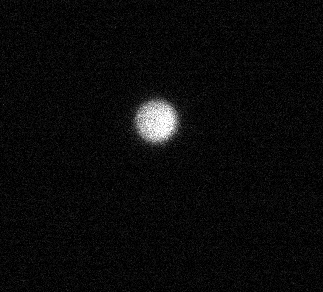
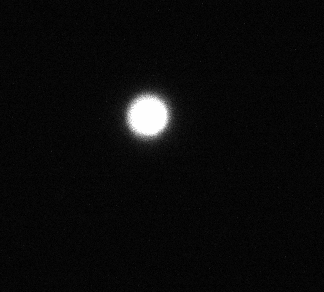
Here are sample raw frames from each of these recordings. Uranus is approximately 3.5 arc-seconds in diameter
and measures approximately 44 pixels across in these frames. This gives an image scale of about 12 pixels per
arc-second.
 |
 |
| 700nm NIR longpass single video frame |
610nm NIR longpass single video frame |
The video data was analysed in several ways as we didn't know if the ring would be visible or how faint it
might be compared to the glare from the planet. Our initial analysis was done by combining several
video runs into a single sequence to maximise any possible signal.
Analysis 1: Combining 3 x video sequences through the 700nm filter for a total of 45 minutes data
Analysis 2: Combining 5 x video sequences through the 610nm filter for a total of 75 minutes data
Analysis 3: Processing each video sequence individually to find the one with the single clearest result
All of these analysis techniques show the ring, however the atmospheric seeing plays a dominant effect
on the clarity of the result so in the end we found the clearest detection in just one of the 610nm
individual sequences that was recorded in the steadiest seeing.
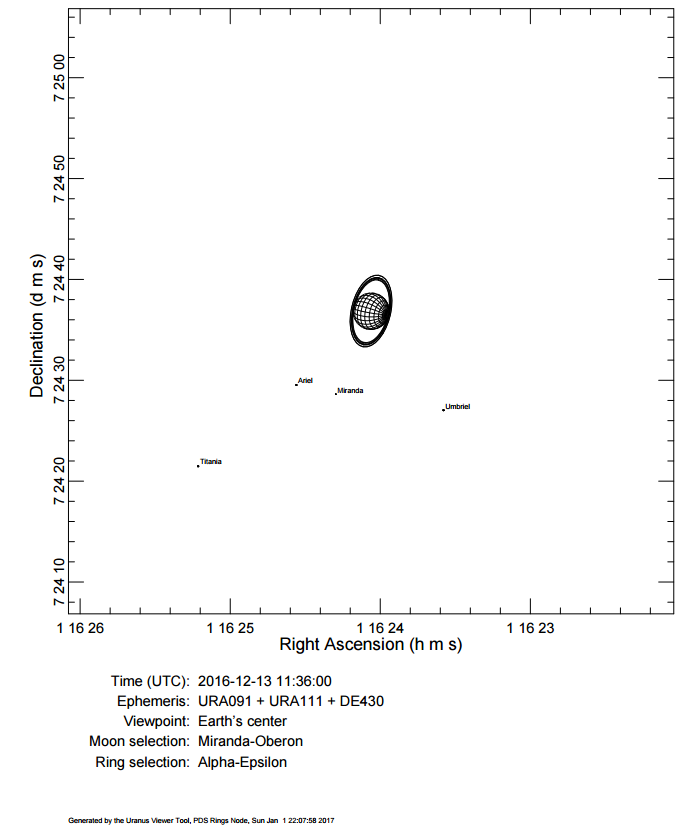
Each processed image is compared to this simulated view that shows the location
and orientation of the ring system as well as the moons Ariel, Miranda and Umbriel as reference.
The reference image is generated using this online resource from the SETI institute.
Analysis 1 - 45 minutes of data @ 5fps, 700nm longpass filter
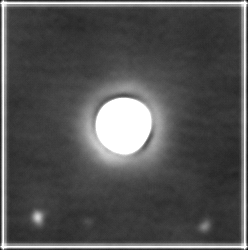 |
45 minutes of data @ 5fps, 700nm longpass filter.
Stacked and enhanced result. 10925 frames |
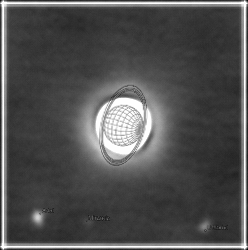 |
Above image overlaid with the reference image to show ring position.
Simulated image has been scaled and rotated using the moons for reference. |
Analysis 2 - 75 minutes of data @ 5fps, 610nm longpass filter
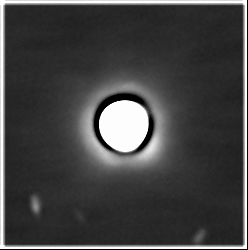 |
75 minutes of data @ 5fps, 610nm longpass filter. Stacked and enhanced result. 18623 frames |
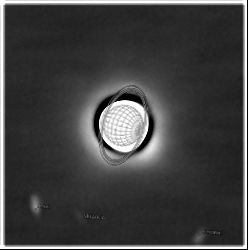 |
Above image overlaid with the reference image to show ring position.
Simulated image has been scaled and rotated using the moons for reference. |
Analysis 3 - Single best recording, 15 minutes of data @ 5fps, 610nm longpass filter
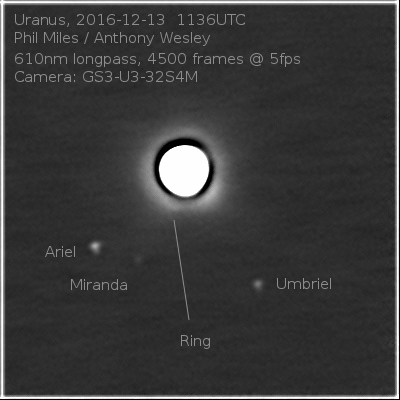 |
15 minutes of data @ 5fps, 610nm longpass filter. Stacked and enhanced result. 4500 frames |
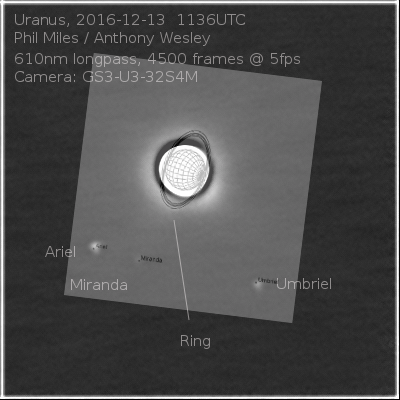 |
Above image overlaid with the reference image to show ring position.
Simulated image has been scaled and rotated using the moons for reference. |
Notes
* The ring is detected in each of these analyses. It is most clearly seen in analysis #3.
* Due to the proximity of the ring to Uranus and its extremely low brightness only the ends of the
ring (ansae) are detected, with the interior lost in the glare and scattered light from Uranus.
* It is noticeable that the lower-left ansae (at 7 o'clock position) is more easily seen than the
opposite end at 1 o'clock. This is not fully understood, but might be explained by either the
known brightness variability in the ring and/or some optical scattering asymmetry in the instrument.
Many of the online images that we consulted for reference (including those captured by HST) show a
marked unevenness in brightness around this ring. It may be that we found a night where the brightest
part of the ring was close to the lower left ansae, increasing its visibility.
* The approach used here (NIR longpass filters) is different to the more generally suggested system of
attempting to image the rings using a narrowband CH4 filter to reduce glare from Uranus itself. The CH4
filter method is used successfully on larger telescopes, however amateur-class instruments generally
do not have enough light gathering ability (ie aperture) for this to be viable as the resulting images
are extremely dim. The long exposure required will result in increased image blur due to movement
in both the instrument and the atmospheric seeing, with the resulting loss in effective resolution possibly
greater than the benefit in contrast from the CH4 filter.
* The successful detection of the rings using NIR pass filters shows an alternative that should be viable for
smaller aperture scopes. Given the results shown here it seems reasonable to conclude that smaller instruments
should be able to detect this ring under conditions of near perfect seeing. At a guess it might be possible for
telescopes down to about 14 inch aperture to successfully detect the very outer edges of the ring using the
generally available NIR longpass filters (610nm / 685nm / 700nm).
references
Note all images are (C)Copyright to their respective owners
[1] Previous detection of Uranus ring using an 800mm telescope in 2011
[2] Uranus ring detection by JL.Dauvergne / F.Colas using the Pic Du Midi 1.06m scope in 2016
[3] Uranus ring detection by M.Delcroix / C.Pellier / JP.Cazard / F.Colas using the Pic Du Midi 1.06m scope in 2016
[4] Uranus ring detection by M.Delcroix / F.Colas using the Pic Du Midi 1.06m scope in 2014